





.png)










Jul 9, 2026
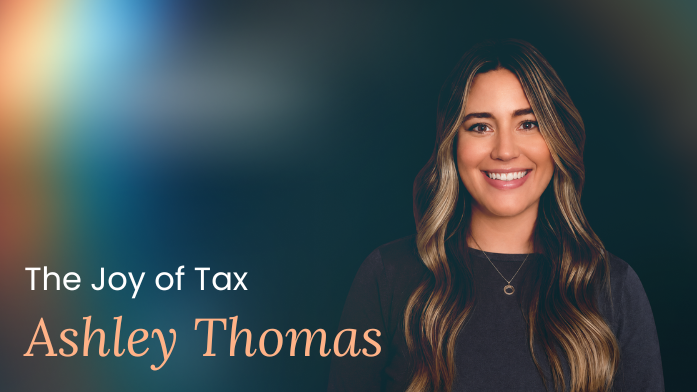
Ashley Thomas on the Joy of Tax
Part of our Joy of Tax series: Gelt tax manager Ashley Thomas on why tax is more law than math, moving fast on an S-corp conversion before a Q4 deal closed, and why trust is the foundation of a great CPA relationship.

Overview
- People assume CPAs love math; Ashley says the work is closer to law: knowing the code and applying it accurately.
- Growing up in her father's CPA office, what drew her in was the client relationships, not the content.
- Gelt's edge is proactive planning: streamlining compliance frees the team to catch opportunities other firms miss.
- Moving fast on an S-corp conversion before a Q4 deal closed kept the extra self-employment tax off the income.
Part of our Joy of Tax series, where we sit down with the CPAs of Gelt to talk about what makes this work matter.
Most people would rather do almost anything than think about their taxes. Ashley Thomas built a career out of it, and if you assume that means she loves numbers, she'll set you straight fast.
"People usually say, oh, you must be good at math, which is a misconception," she says. "The software does most of the math. A lot of it is closer to being a lawyer. You have to know the code, know the tax laws, and be able to apply them to a ton of different situations accurately." The math was never the point. The problem-solving was.
Watch the clip on our channel then read ahead.
How she got here
Ashley grew up around the work. Her father was a CPA, and she spent stretches of high school in his office.
"I worked in his office off and on. Not necessarily the most exciting stuff, because it was just admin," she says. "But I got to see how they operate, and a lot of how they interact with clients, which is really what drew me in." Ten years into public accounting and now a tax manager at Gelt, that early view of the work still defines what she likes about it.
"The content is not always the most exciting, it can be a little dry," she admits. "But the best part of the job is building relationships with your clients, solving problems with them, being creative, helping them with their issues. It's nice for them to know they have someone in their corner when it comes to taxes."
There's a running joke she's learned to deflect. People hear what she does and immediately ask if she'll handle their return. "I say sure, but talk to my customer success team first, please."
The Gelt difference: proactive, not reactive
Ask Ashley what sets Gelt apart after time spent at other firms, and her answer lands on where the hours go.
"Gelt is focused on the client experience much more than other firms I've worked at. We're always trying to improve, streamline, take the burden off the client," she says. "CPA firms tend to get weighed down with all the compliance work. It takes a lot of time to do everything accurately."
The result at most firms is a team stuck in reaction mode. Gelt's bet is that fixing the compliance grind is what frees the CPA to do the valuable part. "Making the compliance process smoother and easier, for both the client and the tax team, frees us up to fill a space where other CPAs maybe just don't have the time or resources to be as proactive in planning."
[cta_block]
Catching the win before the deal closed
Ashley's favorite early win came down to moving fast on a structure change before a big year got even bigger.
One of her first clients was weighing whether to convert his Schedule C to an S corporation, and he had a large deal sitting in the balance in Q4. The timing mattered. If the deal closed while he was still filing as a sole proprietor, that income would land on his 1040 and carry the full self-employment tax with it.
"We got everything up and running really quickly," she says. LLC, S corporation, all of it, set up in time. The deal did go through. "We were able to capture that income within the S corporation rather than reporting it on his 1040, and keep all that extra self-employment tax off it."
She still points to it as one of her more rewarding cases, and not just for the tax saved. "We worked together really quickly and really well. It was a good working relationship."
What separates a great CPA from a good one
Ashley's answer to that question isn't about technical skill. It's about the thing underneath it.
"Having trust with your CPA is always going to be the foundation of a good relationship," she says. "You're dealing with someone's finances, their life circumstances, how things change." The difference between a client who tolerates their accountant and one who genuinely relies on them, in her view, comes down to whether that trust is really there.
That's the throughline of how she works: know the law cold, move quickly when it counts, and be the person in the client's corner they can actually trust.
Frequently Asked Questions
Is being a CPA really about being good at math?
Not the way most people think. As Ashley puts it, "the software does most of the math." The real skill is closer to law: knowing the tax code, understanding the rules, and applying them accurately across a wide range of situations. The value is in the problem-solving, not the arithmetic.
Why does the timing of an S-corp election matter?
Because structure decisions only help if they're in place before the income hits. One client was weighing converting his Schedule C to an S corporation with a large deal pending in Q4. Setting up the LLC and S corporation in time meant that income could be captured inside the S corporation instead of landing on his personal 1040, keeping the extra self-employment tax off it. Had the deal closed first, that window would have been gone.
What makes a great CPA relationship?
Trust. You're handing someone your finances and your life circumstances, so the foundation of a good relationship is whether you can genuinely rely on them, not just tolerate them. Add a firm that stays proactive instead of reactive, and you get an advisor who is actually in your corner.
What does "proactive, not reactive" tax work mean?
Most firms get weighed down by compliance, which leaves little time for planning. Gelt's approach is to streamline the compliance grind so the tax team is freed up to plan ahead, catching opportunities like a well-timed structure change before they slip away.
Want a CPA who's actually in your corner? Talk to a Gelt CPA.
Related Resources
.png)
May 5, 2026
California S Corp Requirements: Complete Guide for May 2026
California S corp requirements for May 2026: Form 100S deadlines, $800 minimum tax, reasonable wages, annual filings, and compliance rules to protect your election.
.png)
Dec 19, 2025
When Your Day Trading Feels Like a Business, But the IRS Disagrees
Day trading can feel like a real business, especially when you’re paying for platforms, data, and research tools. But the IRS doesn’t care how serious you feel. It looks at your actual trading pattern to decide whether you’re an investor or qualify for Trader Tax Status. This piece breaks down the investor vs trader distinction, the key factors the IRS considers, what expenses may be deductible if you qualify, and why many active traders still fall short.
.png)