







.png)










Aug 21, 2026
The Oil and Gas Deduction, Explained: How Drilling Investments Can Offset Ordinary Income
From our webinar with King Operating: how oil and gas investments can create a large first-year deduction against ordinary income, why structure decides everything, and the catch when you exit.

Overview
- Oil and gas is one of the few investments that can produce a large first-year deduction against your ordinary income, including W-2 and active business income, not just passive income.
- The deduction comes from intangible drilling costs, which are often 70 to 85% of your investment and are generally fully deductible in year one.
- The treatment hinges on structure. You usually need a working interest as a general partner, which brings the tax benefit and real liability together.
- The deduction is not free money. It reduces your basis, so you typically pay it back as capital gain when you exit, though usually at a lower rate than the income you offset.
- Make the investment decision first. A deduction makes a good deal better; it never makes a bad deal good.
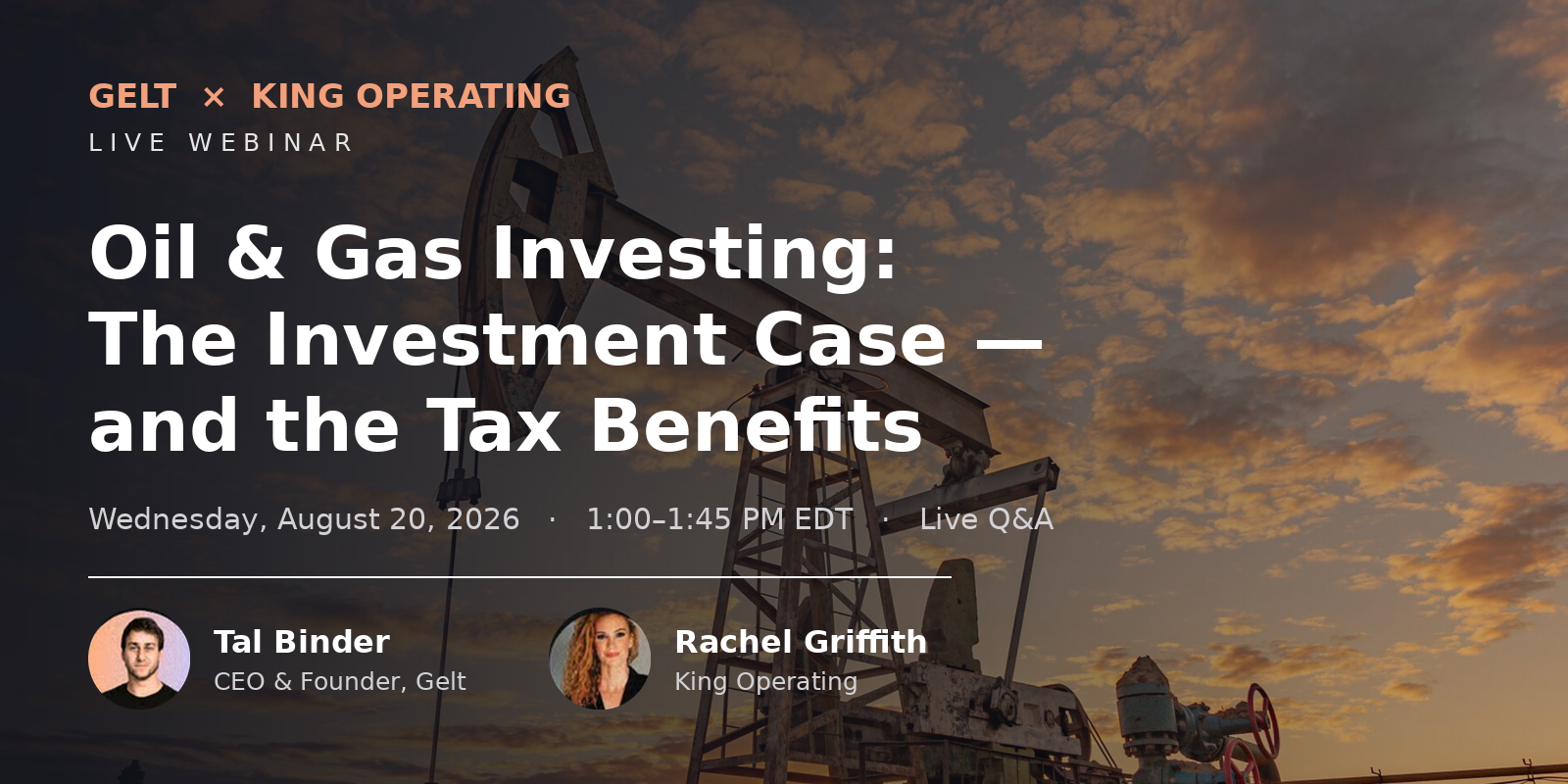
This article is based on a Gelt educational webinar on oil and gas deductions, featuring Rachel Richards, CPA, Gelt's Head of Tax Product, alongside our partner King Operating. It is general information, not tax or investment advice. Every situation is different, and oil and gas investments carry real risk. Talk to your own advisor before acting.
Prefer to watch instead of read? The full session, covering the investment case and the tax walkthrough, is embedded below. Then read on.
Most business owners we work with have already solved the hard part. They know how to make money. The question that follows is harder: how do you make that money work harder, and how much of it do you get to keep?
Oil and gas tax deductions come up in that conversation more than almost any other alternative investment, for one reason. It is one of the only places in the tax code where an investment can hand you a large deduction in year one, and where that deduction can offset the income you are taxed on most heavily. Used well, it is a real planning tool. Used for the wrong reasons, it is a fast way to end up disappointed. Here is how the deduction actually works, what it costs you later, and the questions to answer before you wire a dollar.
Start here: it is an investment first
We will say this more than once because it matters more than anything else in this article. Whether to invest in an oil and gas deal is a separate decision from the tax benefit. Evaluate the economics on their own. Do your due diligence. Ask whether you would still make the investment if the deduction did not exist.
A tax benefit should make a good investment better. It will not save a deal where you are losing money. If the only reason you are interested is the write-off, you are setting yourself up for frustration. Taxes are the cherry on top, not the cake.
With that established, the tax treatment is unusual, and worth understanding.
What makes oil and gas tax deductions different
If you invest in a real estate syndication or most private funds and it throws off a loss, that loss is usually trapped. It is a passive loss, and it can only offset passive income unless the activity is your everyday, hands-on business. Plenty of investors sit on paper losses for five or ten years before they can actually use them.
Oil and gas can work differently. If you invest as a general partner with a working interest, the losses can be non-passive. That means they can offset your ordinary income: your W-2, your active business income, the income taxed at the highest rates you pay. For a high earner, ordinary rates run up to 37% federally, and once you add state tax, the combined rate can sit in the 40s or even reach 50%. Offsetting income taxed at that level is where the value shows up, especially in the early years of the investment.
That word, 'can,' is doing a lot of work. Whether the benefit reaches you depends almost entirely on structure.
Structure decides everything
There are two ways to hold one of these investments, and they lead to very different tax outcomes.
A limited partner has limited liability and, generally, passive losses. Those losses get trapped the same way a real estate loss would.
A general partner with a working interest is the position that opens the door to non-passive, ordinary losses. This is almost always what you need in order to get the tax treatment people come to oil and gas for.
The tradeoff is real. A working interest exposes you to liability, including potential exposure to additional costs beyond what you put in. The tax benefit and the risk are two sides of the same coin. You do not get one without the other, and that is exactly why the benefit exists.
One more structural decision quietly determines your outcome: what you hold the investment inside. Owning a deal through an S corporation or an IRA can block the benefits from reaching you, or change them entirely. These are not small details you can fix after the fact. Get the structure right before you commit, which means looping in your tax advisor while the deal is still on the table, not at filing time.
[cta_block]
The two deductions: intangible and tangible drilling costs
The write-off itself comes from the costs of drilling, which split into two buckets.
Intangible drilling costs (IDCs) are the non-salvageable costs of getting a well going: labor, drilling, site preparation. This is the big one. IDCs are often 70 to 85% of your total investment, and for a general partner with a working interest they are generally fully deductible in year one, as an ordinary deduction. On a $100,000 investment, that alone can mean a $70,000 to $85,000 deduction hitting your return the first year.
Tangible drilling costs (TDCs) are the equipment: the physical assets that get depreciated or depleted rather than expensed all at once. Historically these were recovered over time. Under recent tax law, that has improved. The One Big Beautiful Bill Act reinstated 100% bonus depreciation on a permanent basis for qualifying property acquired after January 19, 2025, which means much of the tangible equipment cost can now be expensed immediately rather than spread across years. The same law also aligned how IDCs are treated for alternative minimum tax purposes with the regular tax treatment, removing a mismatch that used to catch drillers off guard.
Together, these are why a first-year oil and gas deduction can approach the size of the investment itself.
What the K-1 actually shows
When tax season arrives, all of this lands on a Schedule K-1, and a few boxes tell you whether the plan worked. (If K-1s themselves are new to you, we wrote a full guide to reading one.)
The general partner checkbox is the first thing to find. That single box determines whether your losses are ordinary, and usable against your W-2 and business income, or passive and stuck. You should know which side of that box you are on before the K-1 ever arrives. The K-1 should confirm what you agreed to, not surprise you.
Ordinary income or loss is where the working interest pays off. As a general partner, an ordinary loss offsets your ordinary income. Worth noting: if this figure were ever a profit instead of a loss, it would be ordinary income subject to self-employment tax. Great as a loss, a little more expensive as a profit.
Intangible drilling costs flow through in their own box (13J). Combined with the ordinary loss, these are what add up to that large first-year deduction. In a typical first-year example, a $100,000 investment can produce roughly an $85,000 loss flowing straight onto your return.
AMT items and the capital account round it out. If you are subject to alternative minimum tax, certain inputs here can affect your result. And your capital account tells the story of your basis, which is where the catch lives.
The catch: basis, recapture, and the exit
A first-year deduction this large is not a gift the tax code forgot to take back. It is, in large part, timing.
Every dollar of deduction you take reduces your basis in the investment. Follow a simple case. You put in $100,000 and take about $85,000 in first-year losses. Say nothing much happens for a couple of years, and then you exit for the same $100,000 you invested. You did not make a dollar of economic profit, yet you can owe capital gains tax on roughly $85,000, because your basis was written down by the deductions you already took. When you exit, your gain is adjusted for everything that happened over the life of the investment. This is the recapture people ask about.
Here is why it can still be a win rather than a wash. You took the deduction against ordinary income, taxed at your highest rate. You pay it back as capital gain, taxed at favorable long-term rates. You are not just deferring tax, you are potentially converting it from a high rate to a low one. The tax you pay on the way out is often less than the benefit you got on the way in.
And you do not have to trigger it all at once. On exit, a 1031 exchange or reinvestment into other offsetting opportunities can defer the capital gain further. There will be a tax event when you exit. It does not automatically mean a tax bill this year.
Limits, AMT, and extensions
Three practical things to keep on your radar.
Loss limits. A very large loss may be capped in a single year by the excess business loss limitation. If a deal generates, say, a $500,000 loss, you may not be able to use all of it this year. You do not lose the deduction; the excess carries forward. This limit applies across your ordinary business income for the year, including Schedule C losses, and it is separate from AMT.
AMT. Alternative minimum tax is essentially a parallel calculation: you run your taxes under the normal rules and again under AMT rules, and pay the higher number. A year with a lot of deductions is exactly the kind of year that can trigger it, and your AMT loss can differ from your regular loss. This is worth modeling with your advisor rather than discovering in April.
Plan to extend. Because your deduction arrives on a K-1, your filing timeline depends on when the partnership files. Ask for a draft or estimated K-1 so you can plan and pay accurately, but expect to file an extension. Extensions are routine, they are free, and as long as your tax is paid on time, there is nothing wrong with using one. If you do not have your K-1, do not file without it.
A simple way to see the numbers
Put a round example next to all of that. Invest $100,000 in a qualifying deal and take roughly an $85,000 first-year deduction. At a high marginal rate, that deduction can be worth around $31,000 in actual first-year tax savings. Your true out-of-pocket cost in year one is meaningfully less than the $100,000 you invested.
Two cautions on that math. It is illustrative, and your real numbers depend on your rate, your structure, and the specific deal. And an $85,000 deduction does not mean your net cost is $15,000. The deduction saves you tax at your marginal rate, not dollar for dollar. It is a real advantage, and it is not magic.
The Gelt take
Oil and gas is one of the clearest examples of why we do tax planning year-round instead of once a year at filing. The difference between a deal that offsets your W-2 income and one whose losses sit trapped for a decade often comes down to decisions made before you invest: how you are treated on the K-1, what entity holds the position, whether the economics stand on their own. None of that can be fixed after the return is filed.
So if a drilling deal is in front of you, the move is not to chase the write-off. It is to pressure-test the investment first, then structure it so the tax benefit actually reaches you, then plan for the recapture down the road. Get those three right and the deduction does what it is supposed to do: make a good decision better.
Frequently Asked Questions
How can an oil and gas investment offset my W-2 income?
When you invest as a general partner with a working interest, your share of the drilling losses is generally treated as non-passive. Non-passive losses can offset ordinary income, including W-2 and active business income, rather than being trapped against passive income the way most investment losses are. The treatment depends on your structure, so confirm it before you invest.
What are intangible drilling costs (IDCs)?
IDCs are the non-salvageable costs of drilling a well, such as labor, site preparation, and the drilling itself. They typically make up 70 to 85% of an oil and gas investment and are generally fully deductible in the first year for an investor holding a working interest, which is what makes the first-year deduction so large.
Do I have to pay the oil and gas deduction back?
In effect, often yes, through basis. The deductions you take reduce your basis in the investment, so when you exit you can owe capital gains tax even if you only got your original investment back. The upside is that you offset income at ordinary rates and pay it back at lower capital gains rates, and a 1031 exchange or reinvestment can defer the gain further.
Is there a limit on how much loss I can take?
Yes. The excess business loss limitation can cap the loss you use in a single year. You do not lose the deduction; the excess carries forward to future years. This limit applies across your ordinary business income and is separate from alternative minimum tax, which is its own calculation.
Should I invest in oil and gas just for the tax deduction?
No. Evaluate the investment on its economics first and ask whether you would still do it with no tax benefit. A deduction should make a strong investment more attractive, not rescue a weak one. Oil and gas also carries real risk, including the liability that comes with a working interest.
Related Resources
.png)
May 5, 2026
California S Corp Requirements: Complete Guide for May 2026
California S corp requirements for May 2026: Form 100S deadlines, $800 minimum tax, reasonable wages, annual filings, and compliance rules to protect your election.
.png)
Dec 19, 2025
When Your Day Trading Feels Like a Business, But the IRS Disagrees
Day trading can feel like a real business, especially when you’re paying for platforms, data, and research tools. But the IRS doesn’t care how serious you feel. It looks at your actual trading pattern to decide whether you’re an investor or qualify for Trader Tax Status. This piece breaks down the investor vs trader distinction, the key factors the IRS considers, what expenses may be deductible if you qualify, and why many active traders still fall short.
.png)